
Tests
ETT Test Kingston
An ETT, or exercise ECG, records your heart on a treadmill as the pace rises. The appointment takes about 45 minutes and the results are discussed with you face to face.
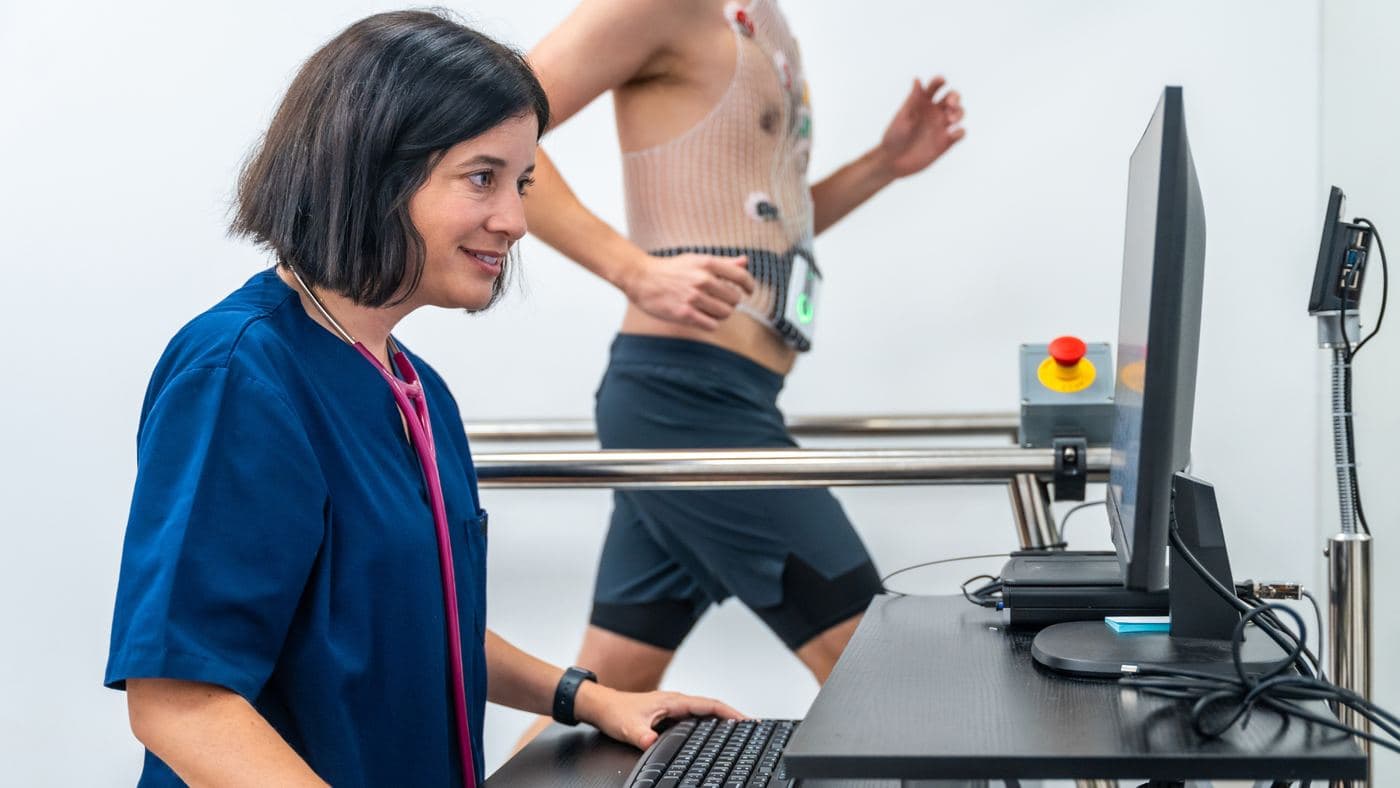
If you're searching for an ETT test in Kingston, the short answer is that an exercise tolerance test (ETT), sometimes called an exercise ECG or treadmill test, can be booked through Kingston Cardiologist, with prompt access to specialist assessment. The test involves walking on a treadmill while your ECG, blood pressure and any symptoms are recorded in real time, with the workload gradually increasing every few minutes. The whole appointment usually takes around 45 minutes, you can drive yourself home afterwards, and the findings are discussed with you face to face.
An ETT is one of the older and more straightforward cardiac investigations, but it remains genuinely useful when used in the right clinical context. An exercise ECG is most valuable when the clinical question is about how the heart behaves under physical stress, rather than what it looks like at rest. It is usually used alongside other investigations rather than as a stand-alone answer, and whether it is the right test depends entirely on the symptoms being investigated.
What an ETT Test Actually Is
An exercise tolerance test is essentially an ECG performed while you exercise, usually walking on a treadmill that gradually gets faster and steeper. We monitor three things continuously: the electrical activity of your heart through the ECG, your blood pressure, and any symptoms you develop, particularly chest discomfort, breathlessness or fatigue.
The principle behind the test is simple. Your coronary arteries can usually deliver enough blood to the heart muscle at rest, even when there's significant narrowing. The mismatch between supply and demand only becomes apparent when the heart is asked to work harder. By controlled exercise on a treadmill, we mimic the kind of effort that triggers symptoms in everyday life, and we can capture the heart's response in a way that a resting ECG simply can't.
The treadmill protocol most commonly used is called the Bruce protocol, where the speed and gradient of the treadmill increase every three minutes through a series of stages. Most patients are able to complete two to four stages before they reach their target heart rate or develop symptoms that lead us to stop the test.
Why an ETT Test Is Performed
There are several reasons an exercise tolerance test might be recommended, and the value of the test depends heavily on the question being asked. The most common reasons include:
Investigating chest pain on exertion. This is the classic use of an ETT. If a patient describes chest discomfort that comes on with effort and eases with rest (the typical pattern of angina), an exercise test can show whether the heart muscle is struggling for blood when worked harder. It can also help identify coronary heart disease before it becomes more advanced.
Assessing exercise capacity. The ETT gives an objective measure of how much exercise your heart can comfortably sustain. This is genuinely useful in patients with known heart disease, in athletes returning after injury or illness, and in those preparing for non-cardiac surgery.
Risk stratification after a heart attack. Once a patient has recovered from a heart attack, an ETT can help us understand how the heart is performing under load and guide rehabilitation.
Detecting exercise-induced arrhythmias. Some rhythm disorders only appear during exertion. An ETT is one of the most reliable ways to capture them, particularly when palpitations are clearly triggered by physical activity.
Assessing the effectiveness of treatment. If a patient has started new medication or undergone a procedure, repeating an ETT can show whether their exercise tolerance has genuinely improved.
Occupational and DVLA assessments. Certain commercial driving licences and other occupational requirements need an exercise test as part of medical clearance.
What Happens on the Day
The practical experience of an ETT is straightforward, and most patients are surprised by how unremarkable it feels. Before you arrive, the usual advice is to avoid a heavy meal in the two hours beforehand, skip strong coffee or tea, and wear comfortable clothing and trainers. Some heart medications may need to be paused for 24 to 48 hours before the test, and Dr Jogiya will confirm this with you individually rather than leaving anyone to guess.
When you arrive, ten ECG electrodes are placed on your chest, similar to a standard ECG, with a blood pressure cuff on your arm. A resting ECG and blood pressure are recorded as a baseline. The treadmill then starts at a gentle walking pace with a small incline. Every three minutes, the speed and gradient increase.
Throughout the test, the ECG is being recorded continuously, your blood pressure is checked every few minutes, and we'll ask how you're feeling at each stage. The test continues until one of several end points is reached: you achieve your target heart rate (roughly 85 per cent of your age-predicted maximum), you develop significant symptoms, the ECG shows changes that suggest the heart muscle is struggling, your blood pressure rises or falls in a way that warrants stopping, or you simply ask to stop.
After the treadmill phase, you'll cool down for several minutes while the recording continues. The total time on the treadmill is usually 8 to 15 minutes for someone in reasonable shape, and the whole appointment takes around 45 minutes to an hour.
You can drive yourself home, return to work, and resume normal activities the same day. There's no recovery period and no restrictions afterwards.
How the Results Are Interpreted
This is where the value of a specialist matters, because an ETT report is more nuanced than a simple positive or negative. Several things are reviewed together.
The ECG changes during exercise are the most important finding. Specific changes called ST-segment depression suggest that the heart muscle isn't getting enough blood at a particular workload. The pattern, timing, depth and which leads are affected all matter.
The blood pressure response tells us how the cardiovascular system is coping. A normal rise during exercise is reassuring. A flat response or, more concerning, a fall in blood pressure during exertion can suggest significant underlying disease.
The exercise capacity itself is a powerful piece of information. The number of minutes you can complete on the standard protocol correlates well with overall cardiovascular fitness and long-term outcomes.
Symptoms during the test, particularly chest discomfort or breathlessness that comes on at a reproducible workload, add real clinical weight to the interpretation.
Interpretation is more reliable when the same clinician oversees the test, watches the patient's response in real time, and discusses the findings with them. Software-generated reports give a starting point, but they miss the clinical context that a sound interpretation depends on.
How an ETT Test Compares to Other Investigations
Cardiology has changed significantly in the past decade, and the ETT now sits alongside several other tests that look at the same kinds of questions in different ways. The honest answer is that no single test is best for every patient, and the right choice depends on the clinical question.
Resting ECG. This shows electrical activity at rest. It can pick up arrhythmias, prior heart attacks and electrical conduction problems, but it tells us very little about how the heart behaves during exertion. An ETT extends what we can learn from an ECG by adding the stress component.
CT coronary angiogram. This is a scan that directly visualises the coronary arteries using a contrast injection in the arm. National guidance now recommends it as a first-line test for many patients with stable chest pain because it gives direct anatomical information about the arteries. That is also why a CT coronary angiogram is often preferred over an ETT in patients with a lower to intermediate likelihood of coronary disease, since it answers the structural question directly rather than relying on indirect signs of trouble.
Stress echocardiogram. This combines exercise (or a medication that stresses the heart) with an ultrasound scan. It adds information about how the heart muscle actually moves under load, which can be more accurate than ECG changes alone, particularly in women, in whom traditional ETT can give more false positive results.
Invasive coronary angiogram. The most accurate test for diagnosing coronary disease, but reserved for patients in whom non-invasive testing has already raised significant concern, since it carries a small procedural risk and the option of treating in the same sitting.
An ETT is most useful when the question is about exercise capacity, symptom reproducibility, or the response of the cardiovascular system to load, rather than when the question is purely about whether coronary disease is present. For diagnostic questions about the arteries themselves, a CT scan or a stress echo is often a better starting point.
Safety and Limitations
ETT is a safe test in the hands of an experienced cardiology team. Major complications, including significant arrhythmias or a cardiac event during the test, are very rare. The test is carried out under continuous cardiac monitoring, with trained staff and resuscitation facilities on hand as standard, so on the rare occasions when something does happen it can be recognised and dealt with immediately.
There are, however, some honest limitations worth knowing about.
The test is less accurate in some groups, particularly women, where false positive rates can be higher. It's also less useful in patients who can't exercise to a meaningful level, whether because of joint problems, lung disease or general fitness.
A normal ETT doesn't completely rule out coronary disease, particularly in patients with significant symptoms. If the clinical suspicion remains high, further investigation is warranted regardless of an unremarkable exercise test.
Certain medications, particularly beta-blockers, can blunt the heart rate response and make it harder to reach a target workload. We'll usually consider pausing these in advance, but only after weighing up the individual situation.
When You Might Need an ETT
Chest pain that comes on at rest, lasts more than 15 minutes or does not settle needs emergency assessment, so call 999, and new or rapidly worsening chest pain on exertion should be discussed urgently with your GP or 111 rather than waiting for a planned test. An exercise tolerance test is worth considering in several other situations. The most common is when a patient describes effort-related chest discomfort, breathlessness, or unusual fatigue, particularly if the resting ECG and echocardiogram are unremarkable but the symptoms are clearly tied to exertion. It's also useful in patients with known heart disease who want a clearer sense of how much they can safely do, in those recovering from a heart attack or cardiac procedure, and in selected athletes or workers needing objective evidence of their exercise capacity.
Less commonly it is used to investigate exercise-induced palpitations, or as a structured way to test whether a treatment is working in someone with stable but symptomatic disease. The test adds most where symptoms have a clear relationship to physical effort, and where the question isn't whether the heart looks normal at rest but how it copes when challenged.
Booking an ETT Test in Kingston
An exercise tolerance test is a straightforward, safe, and genuinely useful investigation when used in the right context. It's at its most valuable when the question is about how your heart behaves under physical stress, when exercise capacity needs to be measured objectively, or when symptoms need to be reproduced under controlled conditions. For the right patient, it adds information that other tests can't provide, and there is real value in having the test, its interpretation and the resulting plan handled by one consultant rather than split across separate services.
If you'd like to book an ETT test in Kingston, are experiencing effort-related symptoms that concern you, or have been advised to consider an exercise stress test as part of your assessment, you can contact me, Dr Roy Jogiya, at Kingston Cardiologist to arrange a private consultation across Kingston-upon-Thames, Wimbledon, or central London. Appointments are available in person and virtually, with full diagnostic support including ECG, exercise tolerance testing and echocardiography, which can often be coordinated alongside or following consultation.
Keep reading